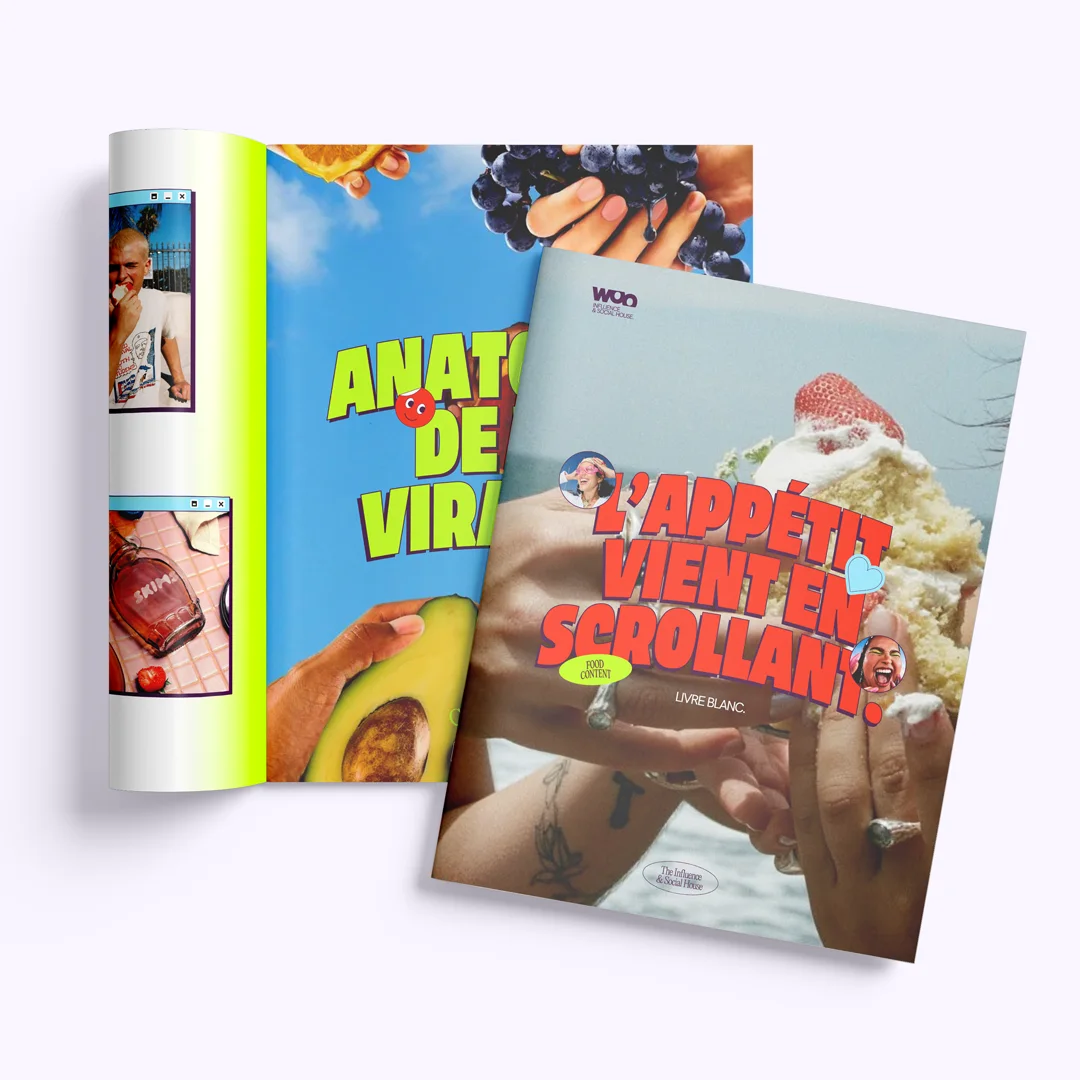


Mass retail will never be the same.
A few years ago, collaborations between an influencer and a brand boiled down to a sponsored story and a promo code. Today, the power dynamic has shifted. Content creators are no longer promoting other people's brands, they are creating their own. And they are crushing it.
Contrary to what many people think, this phenomenon is not just a trend to watch. It is a structural recomposition of the food market that is shaking up retail conventions, reshuffling the deck on consumer trust, and posing a fundamental question to traditional manufacturers: how do you compete with a brand whose CEO and marketing director have 20 million followers on their platforms?
Audience first, product second: an inverted model
For decades, the brand launch model relied on an immutable logic: develop a product, invest in advertising, negotiate distribution, then recruit consumers—slowly, through TV campaigns and end-of-aisle displays.
Today, creators launching their own brands arrive with an advantage that money cannot buy: they already possess the audience, and above all, the trust. And not just any audience, either. The one traditional brands struggle most to reach: the under-30s, who are hyper-connected, resistant to traditional advertising, but ultra-receptive to recommendations from their favorite creator. A consumer who has followed Squeezie for four years doesn't see an ad when he talks about his drink; they hear a trusted person. And that nuance is fundamental.
According to Nielsen (2024), 92% of consumers trust a creator's recommendation more than traditional advertising. In the food sector, where the act of purchasing is as emotional as it is functional, this gap is even more glaring.
Creators who have proven the success of this phenomenon.
Mister V / Delamama (2022)
The founding case in France remains that of Mister V and his Delamama frozen pizzas. Manufacturers watched the launch with suspicion, but reality caught up with them quickly: the pizzas generated 1.4 million euros in revenue in just three months, ranking among the best retail launches of the year. The marketing is offbeat, true to the creator's humorous world, the product is accessible (around 4 euros each), and the community is fully invested.
The signal is clear: turning community capital into real commercial performance is possible.
Andie Ella / Milia Matcha (2023)
At the end of 2023, YouTuber Andie Ella, nicknamed "Madame Matcha" by her subscribers, launched Milia Matcha, her premium matcha brand. With the choice of a rare Okumidori matcha representing 1% of local production in Japan, patented recipes, and an artistic direction designed to "make matcha more fun, modern, and lifestyle-oriented," with a personal investment of 250,000 euros.
What sets Milia Matcha apart is the perfect continuity between the creator and the brand. Andie Ella isn't launching an opportunistic product based on a trend; she has been drinking matcha since she was little and has embodied matcha in her content for years. The launch surprises no one; it confirms an obvious choice.
After an exceptional launch, the brand has seen a string of successes: products frequently out of stock, a pop-up in Seoul and Tokyo in May 2024, then in Paris where lines hundreds of meters long formed as early as 7 a.m. More recently, in March 2026, the opening of three warehouses in Europe to support international development.
Squeezie / Ciao Kombucha then Ciao Energy (2025-2026)
In May 2025, Squeezie launched Ciao Kombucha, with one goal: to offer a substitute for traditional sodas to a generation watching its sugar intake. Behind the launch is a discreet but decisive player: Banger Ventures, Cyrille Jacques' venture studio, specializing in Creator Led Brands, which handles the entire back-office (product development, logistics, retail negotiations).
The results exceeded all projections: €788,000 in revenue in the first month alone, then 23 million euros over the year in a kombucha market that was only worth 6 million in 2024. NielsenIQ named Ciao Kombucha the best beverage innovation of 2025.
Building on this success, the model is gaining even more momentum. On June 1, 2026, Squeezie teamed up with Léna Situations and Inoxtag to launch Ciao Energy: an energy drink with a more transparent, lower-sugar recipe than market standards (4g of sugar per 100ml, compared to 11g for Red Bull), available immediately in 100% of French retail chains. The result: sold out in several Monoprix stores before the official release date.
On the same day, also via Banger Ventures, McFly & Carlito launched Brosti, their quirky-flavored chips, in eight national retail chains.
Our analysis: what this really says about influence in 2026
Trust is the new marketing asset.
What makes these launches so successful isn't necessarily the follower count, but rather the quality of the bond between the creator and their community. Andie Ella has 370,000 Instagram followers, far from Squeezie's 9 million. Yet, Milia Matcha generates revenue and queues worthy of a major brand launch. Why? Because her followers have been following her for years, know her daily life through her weekly YouTube vlogs, and perceive her as a person before a brand. At the same time, Milia Matcha has also managed to attract customers who don't consume Andie Ella's content, thanks to the consistency and quality of its products. This capital cannot be bought. It is built over time.
For brands looking for creator partners, this is the key takeaway: engagement rate and the longevity of the creator-community relationship matter infinitely more than raw audience size.
Where is the line between bold marketing and a lack of ethics?
Mohamed Henni / Klüb Kebab (2024)
En février 2024, le youtubeur marseillais Mohamed Henni comptait 10 millions de followers. Connu pour ses débriefs enflammés des matchs de l'OM, il lance Klüb Kebab en partenariat avec l'opérateur No Brainer, spécialiste de la restauration halal digitale. Concept minimaliste : des kebabs authentiques, sans fioritures, livrés exclusivement via Uber Eats et Deliveroo.
This case perfectly illustrates the limits of the model when communication takes precedence over substance. In March 2024, Kylian Mbappé's lawyers sent a formal notice to Mohamed Henni for describing his bread as "as round as Mbappé's head". The creator turned it into a performance, went viral, and orders doubled the next day. It is an example where a legal incident mechanically becomes an advertising campaign, but it raises questions about the stability of a model where spectacle and ethical boundaries take a backseat to product quality.
The United States is already 10 years ahead.
To understand where France is heading, we must look across the Atlantic, where the phenomenon is 10 years ahead.
MrBeast / Feastables is the most spectacular example. Launched in 2022 with chocolate bars, the brand generated $250 million in sales and $20 million in profit in 2024, more than the revenue from his YouTube channel.
Beast Industries is valued at $5 billion, with investors betting on a consumer goods empire rather than viral videos. In 2025, Feastables entered Carrefour France shelves, with a local activation strategy involving French creators (Mastu, FastGoodCuisine, etc.).
Logan Paul & KSI / Prime reached $1.2 billion in revenue in 2023, becoming one of the best-selling energy drink brands in the UK within two years.
Emma Chamberlain / Chamberlain Coffee also proves the long-term trajectory: launched in 2020, the project evolved from an online coffee brand to opening a physical café in Los Angeles in 2025, with strategic investors on board.
Ces cas posent une question directe au marché français : si la France suit la même trajectoire avec 10 ans de décalage, où en sera-t-on en 2030 ?La creator economy n’a pas fini de nous surprendre, il est temps de la prendre au sérieux.
